

Learn the basic vocabulary needed to understand a weather forecast
FOLLOW ESL DIRECTIONS ON
THIS WEEK’S FEATURED POST

Week of Mar. 23/26
This lesson plan will teach your beginner ESL students the names and significance of common landmarks in Canadian cities. Activities include vocabulary building, a short video, discussions, and reflection questions to help students articulate their…
Keep reading
Lesson plan overview
| Task | To learn the basic vocabulary needed to understand a weather forecast. |
| CLB level | CLB Stage I (CLB 1-3) |
| Delivery method | Online |
| Class size | 10-15 students (vary the number of activities according to your class size) |
| Estimated time | 1.5 hours (depending on class size) |
| CLB Skills and Competencies | Speaking: Interacting with others Sharing information Listening: Interacting with others Comprehending information Reading: Comprehending information |
| Language focus | Learn the vocabulary needed to understand this topic. Create brief sentences using weather vocabulary, e.g., “It is a sunny day today.” One activity includes an optional grammar challenge, focusing on understanding adjectives and nouns. Use the appropriate grammar structures and vocabulary to respond personally to the reflection questions. (Encourage students to respond in full sentences.) |
| Cultural focus | Students discuss the importance of weather forecasts in Canada, especially during times of extreme weather. |
| Specific task learning objectives | Students learn basic vocabulary related to weather forecasts. Students can match weather types with symbols used in weather reports. Students create brief sentences using weather vocabulary. Students understand a basic weather forecast, including how to pronounce Canadian temperatures (e.g., 20° C). Students practice what they’ve learned using a real 7-day forecast from Environment Canada. Students discuss where to find weather forecast information and what weather conditions might be hazardous in Canada. |
| ESL Directions original video (🎥) and audio (🔊) activities? | This lesson plan includes video (🎥) and audio (🔊) activities. |
| Resource attribution | ESL Directions original resources are marked below with an asterisk (*). Feel free to use these, but please give credit to ESL Directions. |
Lesson plan
Warm-up: Introducing the topic and defining our terms
- Today, we’re going to talk about weather forecasts.
- What is weather?
- What is a weather forecast?
- What are some words related to weather forecasts?
Skill-building activities
- Weather vocabulary: Fliptiles*
- Listen to the vocabulary again* (Think about how to say each word and what it means. This activity includes an optional grammar challenge.) 🔊
Skill-using tasks
FEATURED CONTENT
- Match weather vocabulary and pictures*
- Match weather vocabulary with weather symbols*
- Weather symbols practice: Pair or no pair*
- Listen to a seven-day weather forecast* 🎥
- Let’s listen to a weather forecast* (Listen to and read a weather forecast. Answer questions about each day’s forecast.) 🔊
Assessment/review tasks
- Let’s go to a real forecast (Students will look at the Environment Canada 7-day forecast for Edmonton, Alberta. Notice some of the new words used, e.g., “clear” for nighttime forecasts, “showers” for light rain.)
- Weather vocabulary: Quiz*
- Win or lose quiz*
- Spin the wheel review* (Use full sentences to describe the type of day.)
Reflection questions
- Where do you look at weather forecasts, e.g., Environment Canada, Weather Channel, radio, other?
- Why is it important to look at forecasts during winter? What weather can be dangerous in winter?
- Why is it important to look at forecasts during the summer? What weather can be dangerous in summer?
- Do you have a story about the weather in Canada?
RELATED PAGES

Understanding weather forecasts (for advanced beginners)
This lesson plan for ESL beginners teaches the basic vocabulary needed for understanding weather forecasts. The plan includes various activities focused…
Keep reading
Winter weather
This lesson plan will teach basic winter weather vocabulary to ESL students at CLB Stage I (CLB 1-3). Activities include discussions…
Keep readingCANADA YOUTUBE PLAYLIST
Click the small arrow at the top right of this video to play the videos or go to the YouTube Canada Playlist.
CANADA WORDWALL ACTIVITIES
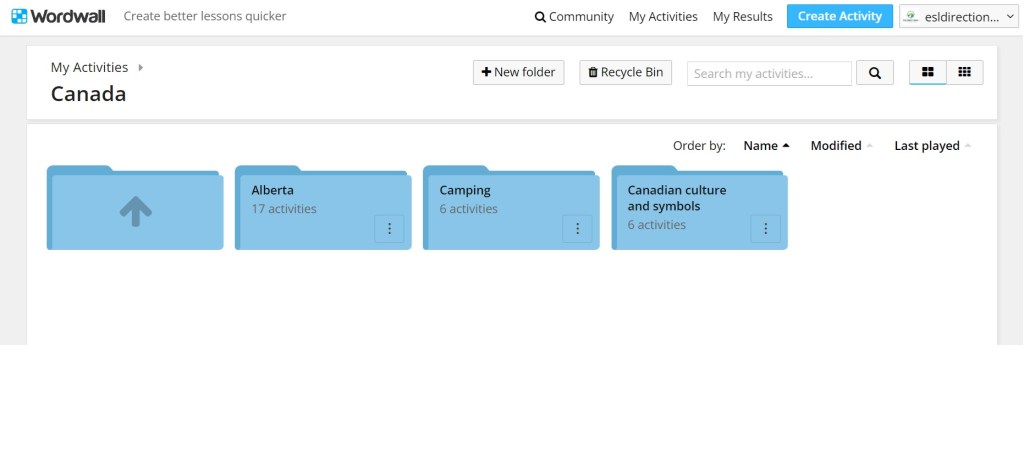
Wordwall is a very useful interactive lesson-creation site. If you sign up for a free Wordwall account, you will be able to see our “Canada” folder, which includes ESL Directions activities that you can add to your lessons.
SHARE THIS PAGE:









ABOUT ESL DIRECTIONS
ESL teacher, movie buff, constant reader, and former editor and communications pro. Now a graduate of the Teaching English as a Second Language program at the University of Manitoba and an ESL teacher in Edmonton, Alberta, I specialize in teaching online classes of beginner ESL students.
FOLLOW ESL DIRECTIONS ON



 ESL Directions